

Comparative Study of Technologies
Applied to Perimeter Protection for
Critical Infrastructure

A comparative study and effectiveness evaluation
according to
Defense-in-Depth criteria
INTRODUCTION
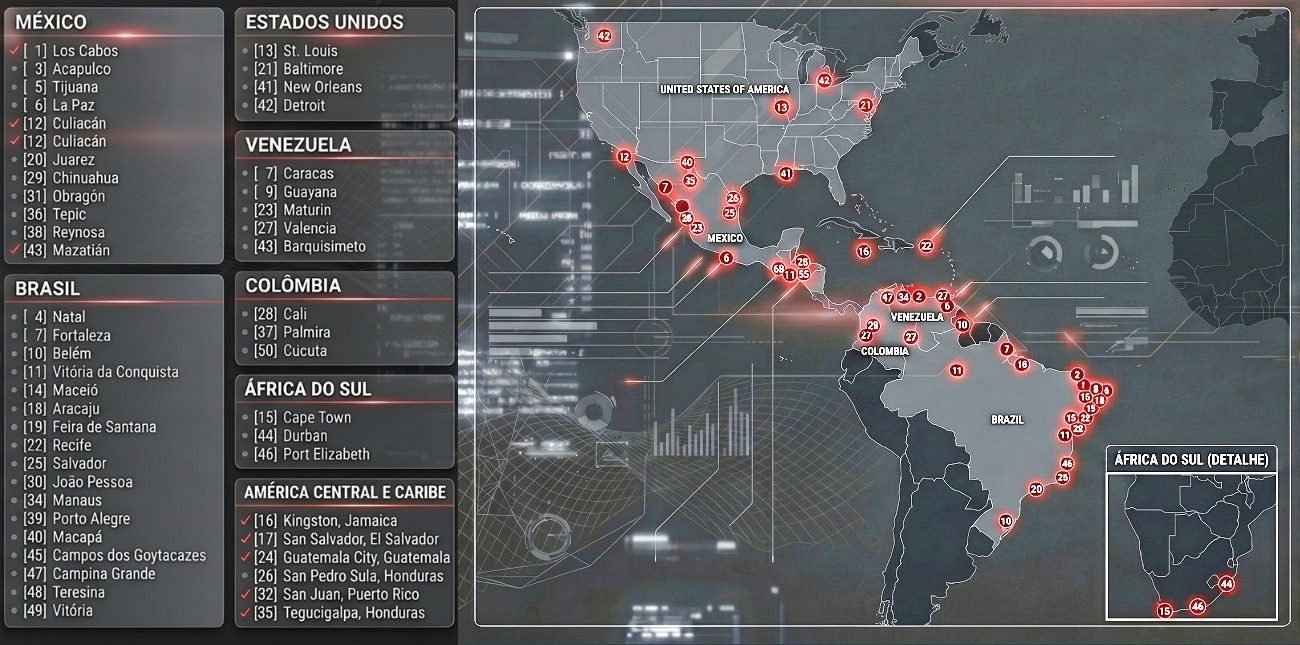
The perimeter security landscape in countries with high levels of violence, as shown in the map of the fifty most violent cities in the world, is characterized by complex challenges stemming from both the sophistication of intrusion tactics and the diverse environmental and regulatory landscape of the country.
Protecting critical assets and private property requires an approach that goes beyond simply installing physical barriers, demanding the integration of technologies that operate synergistically. The vulnerability of extensive perimeters and the need to reduce false alarms drive the search for solutions that offer not only resilience, but also operational intelligence.
Intrusion Detection Systems (ASTM INTERNATIONAL. ASTM F3050: Standard Guide for Perimeter Intrusion Detection Systems. PIDS), in countries with high levels of violence, as shown on the violence map, do not meet the criteria for Perimeter Protection today, since they only detect an intrusion and lead to a confrontation between the criminal and the armed security team. And, the confrontation between armed security and criminals in countries with a high homicide rate produces disastrous results.
The rationale for this study lies in the lack of comparative analyses that use standardized technical criteria to guide decision-making in capital investments (CAPEX) and operating expenses (OPEX). Frequently, the choice of a protection system is based on immediate costs or market trends, neglecting the Defense-in-Depth doctrine , which advocates the layering of defensive structures to deter, detect, delay, and prevent adverse actions.
Many studies fail because they attribute automatic superiority to sophisticated sensors (Radar, DAS, AI, etc.) simply because they detect better. “Isolated detection does not mean effective protection.”
This matrix seeks to avoid this error by considering, among other factors, the psychological effect, physical barrier, intrusion time, robustness, maintenance, and life cycle.
The overall objective of this study is to evaluate and classify the main perimeter protection systems available on the market, using effectiveness criteria based on international standards and concepts.
The methodology employed is based on the construction of a comparative matrix with a scale of 0 to 5 for each criterion, followed by an analysis of the consistency of the assigned weights.
To ensure the robustness of the data, the results were validated by an international committee composed of security professionals from various countries, with over 25 years of proven experience in thousands of Perimeter Protection projects, based on the principles of Defense-in-depth , ensuring a global perspective on the applicability of the technologies analyzed, especially in countries with a high degree of violence in crimes against life and property.
2. DESCRIPTION OF EVALUATION CRITERIA
For the composition of the analysis matrix, nine fundamental criteria were selected, each anchored in normative guidelines that guarantee the objectivity of the technical evaluation:
- Demarcation: Refers to the system’s ability to visually and legally delimit property boundaries. This criterion is essential for the legal characterization of trespassing or invasion of domicile or property, according to the principles that establish standards for the installation and signage of barriers . (Weight 4 in Relevance to perimeter protection)
- Deflection: Evaluates the effectiveness in discouraging intrusion attempts even before physical contact with the barrier. It is based on the doctrine of Psychological Deterrence described in UFC 4-022-03, where the perception of difficulty imposed by the system induces the intruder to seek less protected targets. ( Weight 4 in the Relevance of perimeter protection)
- Deterrence: This differs from deflection by focusing on immediate impact to stop the intruder’s progress after the first contact or attempted breach. Systems with high deterrence provoke an instinctive retreat reaction, either through controlled electric shock or high-intensity audible/visual alarms. (Weight 4 in the Relevance of perimeter protection)
- Detection: Measures the sensitivity and accuracy of the system in generating real-time alerts about breaches. The analysis considers the ability to distinguish between real threats and false alarms caused by environmental factors, following the requirements of IEC 62676 for video surveillance and analytics systems. (Weight 5 in the Relevance of perimeter protection)
- Delay: Physical capacity to delay the intruder, providing sufficient time for response teams to reach the scene. This criterion is based on ASTM standards F2780, F2815, and F2006, which test the resistance of materials against cuts, climbing, and impacts. ( Weight 3 in the Relevance of perimeter protection)
- Durability: Analyzes the system’s resistance to corrosion, weathering, UV radiation, and technological obsolescence. It is a critical factor in ensuring that the investment maintains its operational effectiveness over lifecycles exceeding 10 years. (Weight 5 in the Relevance of perimeter protection)
- Identification: Ability to provide visual, telemetry, or biometric data that allows for the identification of the intruder and the collection of evidence for forensic purposes, as recommended by IEC 60839. (Weight 5 in the Relevance of perimeter protection)
- Maintenance: Assesses the ease of operational maintenance, the availability of spare parts in the national market, and the need for specialized labor for preventive and corrective repairs. (Weight 2 in the Relevance of perimeter protection).
- Cost: Analyzes the ratio between the initial investment (CAPEX) and the operating and maintenance costs (OPEX), seeking the best financial balance for the organization without compromising security. (Weight 3 in the Relevance of perimeter protection).
3 - ITER CRIMINIS – The Path of Crime. – An analysis under the Defense-in-Depth doctrine .
In both crimes against life and crimes against property, there is a concept originating from Roman law called Iter Criminis , which means the path of the crime.
Every crime, whether against life or property, has four steps, namely:
- The first step is contemplation , when the criminal imagines the crime and considers perpetrating it.
- The second step is preparation , when he performs preparatory acts, plans, and observes the target in order to carry out the criminal action.
- The third step is execution , where he will do what the law defines as a crime.
- And the fourth step is the consummation, when he commits the crime and achieves the intended result.
In crimes against property, three of these four steps occur outside or on the property line.
Only the last one takes place inside the property.
Given the iter criminis (the path of a crime), effective perimeter protection is that which prevents the consummation of a criminal act by entering the perimeter.
Therefore, the entire security plan must prevent the crime from being committed, that is, it must keep the criminal outside.
In this sense, Deflection, Deterrence, and Delay assume the greatest relevance when the subject is Perimeter Protection in the Defense-in-Depth doctrine .
Without the elements of Deflection, Deterrence and Delay, the criminal / intruder can enter the property unimpeded.
If there is only detection, a prompt response, usually armed, will be necessary to confirm their presence.
If the thief enters unarmed, it’s less bad.
However, in countries with high levels of violence and lethality, a confrontation with the thief will certainly be a traumatic experience, because to transform robbery into homicide, a single false move by the victim is enough.
4. PROPOSED WEIGHTED SCALE FOR GREATER ANALYSIS ACCURACY.
For highly critical scenarios, this study proposes a differentiated
weighting, prioritizing the pillars of the Defense-in-Depth doctrine.
The new weight distribution aims to value systems that directly
contribute to interrupting the intrusion cycle:
Comparative matrix of the effectiveness of technologies applied in Perimeter Protection - Investment for 10 years.
| Comparative Technologies | Question: Does the technology under analysis effectively meet each of the requirements below? | Total Nominal Points | ||||||||
|---|---|---|---|---|---|---|---|---|---|---|
| Demarcation | Deflection | Deterrence | Detection | Delay | Durability | Identification | Maintenance | Cost | ||
| Monitored Electrified Fence | 5 | 4 | 5 | 5 | 5 | 4 | 2 | 3 | 4 | 37 |
| Physical Fence | 5 | 3 | 3 | 0 | 4 | 5 | 0 | 4 | 5 | 29 |
| Radar/Microwave | 1 | 2 | 1 | 5 | 1 | 5 | 4 | 3 | 3 | 25 |
| Fiber Optic DAS | 1 | 1 | 1 | 5 | 1 | 4 | 3 | 2 | 3 | 21 |
| Vibration Sensors | 1 | 2 | 1 | 4 | 1 | 3 | 2 | 3 | 3 | 20 |
| Video AI | 1 | 1 | 1 | 4 | 0 | 3 | 5 | 2 | 3 | 20 |
| Thermal Video | 1 | 1 | 1 | 5 | 0 | 4 | 4 | 2 | 2 | 20 |
| IR/Laser Beams | 1 | 1 | 1 | 4 | 0 | 3 | 1 | 3 | 3 | 17 |
| Human Patrol | 1 | 3 | 3 | 3 | 2 | 2 | 4 | 1 | 1 | 20 |
| Buried Cables | 0 | 1 | 0 | 4 | 0 | 3 | 2 | 2 | 2 | 14 |
(*) Systems are listed from highest to lowest overall ranking. Scoring scale: 0 = Does not meet. 5 = Meets with excellence.
Factors to consider when evaluating the importance of this item in perimeter protection.
| Comparative Technologies | Question: How important is this factor in perimeter protection? | ||||||||
|---|---|---|---|---|---|---|---|---|---|
| Demarcation | Deflection | Deterrence | Detection | Delay | Durability | Identification | Maintenance | Cost | |
| Importance in Perimeter Protection | 4 | 4 | 4 | 5 | 5 | 3 | 5 | 2 | 3 |
(*) Importance is listed from highest to lowest overall ranking. Scoring scale: 0 = Not important, 5 = Very important.
Weighted Matrix for comparing perimeter monitoring technologies (*) Weighted Average
| Comparative Technologies | Results of Weighted Scores based on Effectiveness criteria in the Defense-in-Depth Doctrine. | Total Weighted Points | ||||||||
|---|---|---|---|---|---|---|---|---|---|---|
| Demarcation | Deflection | Deterrence | Detection | Delay | Durability | Identification | Maintenance | Cost | ||
| Monitored Electrified Fence | 20 | 16 | 20 | 25 | 25 | 12 | 10 | 6 | 12 | 146 |
| Physical Fence | 20 | 12 | 12 | 0 | 20 | 15 | 0 | 8 | 15 | 102 |
| Radar/Microwave | 4 | 8 | 4 | 25 | 5 | 15 | 20 | 6 | 9 | 96 |
| Fiber Optic DAS | 4 | 4 | 4 | 25 | 5 | 12 | 15 | 4 | 9 | 82 |
| Vibration Sensors | 4 | 8 | 4 | 20 | 5 | 9 | 10 | 6 | 9 | 75 |
| Video AI | 4 | 4 | 4 | 20 | 0 | 9 | 25 | 4 | 9 | 79 |
| Thermal Video | 4 | 4 | 4 | 25 | 0 | 12 | 20 | 4 | 6 | 79 |
| IR/Laser Beams | 4 | 4 | 4 | 20 | 0 | 9 | 5 | 6 | 9 | 61 |
| Human Patrol | 4 | 12 | 12 | 15 | 10 | 6 | 20 | 2 | 3 | 84 |
| Buried Cables | 0 | 4 | 0 | 20 | 0 | 9 | 10 | 4 | 6 | 53 |
(*) Weighting was implemented to establish greater accuracy in obtaining a more assertive result in decision-making.
4.1. Annotated Matrix with Normative Justifications
The table below presents the correlation between the evaluation criteria for Monitored Electric Fence technology and the respective normative bases that support the assigned scores.
| Criterion | Notice | Regulatory and Technical Justification |
|---|---|---|
| Demarcation | 5 | UFC 4-022-03 defines the fence as an unambiguous perimeter boundary, while IEC NBR 60335-2-76 requires clear visual signage. |
| Deflection | 4 | Based on the concept of "Psychological Discouragement" cited by the DHS and documented in manuals by the JVA South Africa and Australia. |
| Deterrence | 5 | According to Norman (2021), IEC 60335-2-76 defines shock as "non-lethal active deterrent", resulting in a high abandonment rate. |
| Detection | 5 | Mandatory requirement of IEC NBR 60335-2-76 for monitoring the cutting or grounding of fence wires. |
| Delay | 4 | The DOE Physical Protection Systems Guide defines delay as the ability to slow down the advance; electrification requires insulated tools and extra time. |
| Durability | 4 | Environmental stress tests as specified in IEC 60335 ensure operation in adverse weather conditions for extended periods. |
| Identification | 2 | Identification depends on integration with video systems (UFC 4-021-02). |
| Maintenance | 3 | Following NBR 5410 and manufacturer manuals ( JVA ), preventive inspections are required to ensure conductivity. |
| Cost | 4 | JVA 's TCO (Total Cost of Ownership) analyses demonstrate high financial efficiency compared to buried sensors or radar. |
5. Comparative Analysis and Final Ranking
The final result, which ranks the technologies in descending order of multifactorial efficiency, according to the effectiveness ranking of perimeter protection systems, is logically structured as shown in the table below:
| Position | Technology Analyzed | Nominal Score | Score Thoughtful | Technical Highlight |
|---|---|---|---|---|
| 1st Place | Monitored Electric Fence | 36 points | 141 points | Superior in Demarcation, Deterrence, Detection, and Delay. |
| 2nd Place | Traditional Physical Fence (Concertina/Gradil) | 29 points | 104 points | Focus on Delay and Low Cost |
| 3rd Place | Radar Systems / DAS / Vibration | 22 points | 91 points | Excellence in Early Detection |
| 4th Place | AI and Thermal Video Analytics | 20 points | 85 points | Superiority in Identification |
| 5th Place | Human Patrol / Buried Cables | 20 points | 84 points | OPEX and Visibility Limitations |
The Monitored Electric Fence has consolidated its position as the leading option due to its multifunctional nature: it simultaneously acts in demarcation, diversion, deterrence, and detection.
Its compliance with IEC 60335-2-76 allows for a safe and legally sound installation, offering the best cost-benefit ratio for industrial and commercial perimeters.
Radar and DAS systems, while technologically superior in detection, lose ground in the overall ranking due to the absence of physical delay barriers and the high implementation cost.
The coherence of the matrix lies in the fact that no technology is presented as a perfect solution (perfect score in everything), respecting the known physical and electronic limitations in the security market.
Considering these factors, systems that combine robust Energized Barriers and intelligent video analysis, along with sensor redundancy, demonstrate superior performance, showing that technological integration is the path to maximum effectiveness.
6. The ideal solution in perimeter protection.
The Defense-in-Depth doctrine does not evaluate or advocate a single technology as the perfect solution for perimeter protection.
Rather, it advocates for a multi-layered solution that complements each other and offers an ideal, mature perimeter protection security architecture.
| Layer | Technology |
|---|---|
| Deterrence | Electric Fence |
| Early Detection | Radar |
| Classification | Video AI |
| Identification | PTZ + Analytics |
| Delay | Physical Fence |
| Response | Patrol or Drone |
In other words: Efficiency emerges from integration
Applying the Defense-in-Depth doctrine in the context of countries with high and very high levels of violence and lethality requires a deep understanding of local limitations.
It can be observed that the effectiveness of a system is not measured by its technological complexity, but by its effectiveness across the nine criteria analyzed, in addition to its integration capabilities.
A perimeter protected only by high-resolution cameras or sensors is useless if there is no physical barrier that delays or detains the intruder long enough for intervention.
This study reinforces that perimeter protection should be viewed as a system of systems.
The technical recommendation for high-risk environments is the adoption of the
“Perimeter Triad” : a high-delay physical barrier, a low-false-alarm-rate
electronic detection system, and a visual identification layer for remote
verification.
7. CONCLUSIONS &
RECOMMENDATIONS
At the end of this study, we present a matrix as a robust, balanced, and technically defensible instrument.
It accurately reflects the necessary trade-offs in perimeter security projects. Submitted to an international group, the following adjustments are recommended to increase the document’s acceptance:
- Weights are based on a standard risk environment and temperate climate, as extreme conditions alter Durability.
- Although the matrix uses equal weights, in real projects, Detection and Delay may have a greater weight than Demarcation.
This study concludes that the Monitored Electric Fence remains the most balanced solution for the Countries and cities with high crime rates, according to a world crime map.
When weighted factors are applied, the Monitored Electric Fence still remains the most efficient and effective solution for the Countries and cities with high crime rates, achieving 146 points on the effectiveness matrix.
For critical infrastructures, the recommendation is to use hybrid models that utilize at least two additional redundancies, in sensors for early detection and identification, and VMS ( Video Management System ) platforms with artificial intelligence.
It is recommended that security managers conduct periodic audits based on ASTM F2006 standards to validate the maintenance of delay and detection levels.
Future research should focus on the impact of 5G technology on reducing the latency of remote sensing systems and the use of autonomous drones as an immediate response layer in large perimeters.
The following people
Perimeter Protection Specialists participated in this study:
| Prepared by | Company | City-State | Country |
|---|---|---|---|
| Bailey | Owner Pro Fence Philippines | Philippines & Malaysia | |
| Benjamin Caro | Pro TG | Santiago | Chile |
| Billy Pullen | Perimeter Protection Specialist | Lockhart-Texas | USA |
| Ernie del Sol | R&D Amarok | Columbia, SC | USA |
| Gavin Bulford | Stafix Security Centres | Johannesburg | South Africa |
| Grant Schwikkard | JVA Electric Fence - Pakton | Brisbane | Australia |
| John Sim | Simtec UK ex-Military | United Kingdom | |
| Jorge Jimenes | H&J Tech - Electrical Engineer | Bogota | Colombia |
| Maurice Williamson | JVA South Africa | South Africa | |
| Mauricio Alves | Top Vision Security - JVA Brasil | Sao Paulo | Brasil |
| Mehul Mistry | A1 Fence | Mumbai | India |
| Patrick Malon | Consultant Safeguard Zimbabwe | Zimbabwe | |
| Paul Thompson | Engineer - Pakton Technologies | Brisbane | Australia |
| Peter Hayes | Instarect | Kenya, Uganda, Tanzania | |
| Shaun Williamson | CEO JVA - South Africa | Johannesburg | South Africa |
| Steffen Horizont | Horizont Group GmbH | Korbach-Hesse | Germany |
8. Normative and Bibliographical Basis.
- Michael Khairallah (Perimeter Security): Comparative technical analysis between detection technologies and physical barriers.
- DOE Physical Protection Systems Guide: Methodology for calculating delay time and probability of detection.
- DHS Physical Security Criteria: Compliance standards for protecting federal assets and sensitive infrastructure.
- IEC 60335-2-76 (International): Global standard that defines the parameters for non-lethal shock and operational safety.
- JVA Z-Series Manual: Detailed technical documentation on line monitoring and system redundancy.
- Thomas L. Norman (Effective Physical Security): Theoretical basis for integrating electric fencing into the concept of defense in depth.
- ABNT NBR IEC 60335-2-76: Main legal and safety standard for products in Brazilian territory.
- UFC 4-022-03 (DoD): Performance criteria for fences and gates in high-security installations.
Contact: Billy Pullen
Email: billy@jva-us.com
Cell: +1-512-466-1859
4838 FM 2001, Lockhart
Texas 78644
USA
Website: www.jva-usa.com